
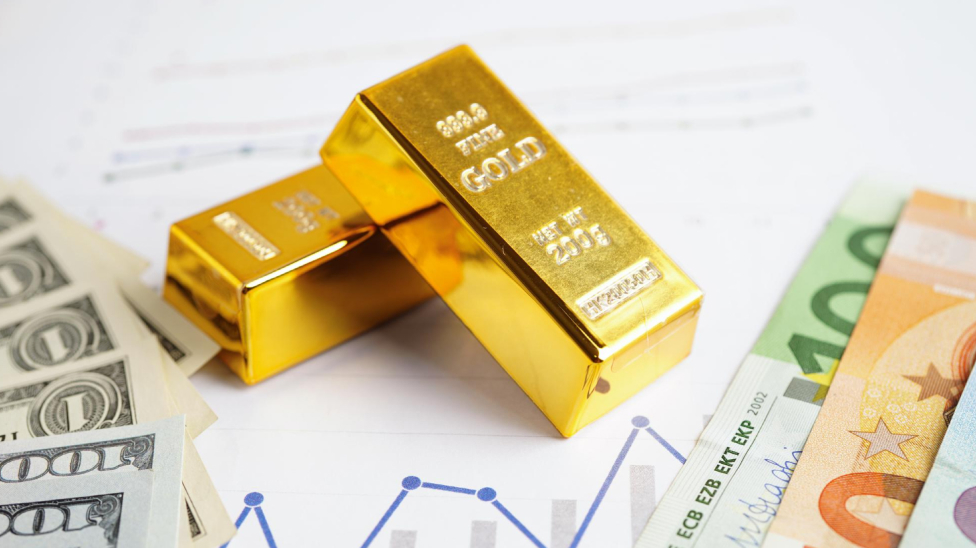
What is gold trading?
Gold trading means buying or selling gold, or a contract linked to its price. On a trading platform, XAU/USD shows the price of one troy ounce of gold in US dollars. A rise from 3,000 to 3,010 means an ounce costs US$10 more. Your gain or loss depends on your position size, the direction of the trade and your costs.
It is one of the busiest markets in the world. The World Gold Council puts average gold trading volume in 2025 at a record $361 billion a day. Prices move for reasons most people can follow: interest rates, the dollar, inflation and political risk. That mix of depth and clear drivers is why gold sits next to the major currency pairs on most trading platforms.
A short history of gold
Gold has been used as money for more than 2,500 years. The kingdom of Lydia, in what is now Turkey, struck the first pure gold coins around 550 BC, and for most of the time since, currencies were tied to the metal in some way.
Britain formally adopted a gold standard in 1821, and most large economies had followed by 1900. Under the system, paper money could be exchanged for a fixed weight of gold, which tied the supply of money to the size of a country’s reserves.
In 1944 the Bretton Woods agreement fixed gold at $35 an ounce and pegged other currencies to the dollar. That arrangement ended in August 1971, when President Nixon stopped the conversion of dollars into gold. Gold has traded freely since then, and the table shows where the price has gone.
Gold price milestones
| Year | What happened | Gold price (US$ per ounce) |
| 1944 | Bretton Woods agreement fixes the price | 35 |
| 1971 | US ends dollar-to-gold conversion | 35, then free-floating |
| 1980 | Inflation-era peak in January | 850 |
| 1999 | Two-decade low | About 252 |
| 2011 | High after the global financial crisis | Above 1,900 |
| 2020 | First move above $2,000 | Above 2,000 |
| 2025 | Passes $3,000 in March and $4,000 in October | Above 4,000 |
| 2026 | Record in late January, then a sharp fall | Near 5,600 at the peak |
The milestones show how far gold can move in either direction. A trader who bought near the 1980 peak faced a very different outcome from one who bought near the 1999 low.
Why do traders choose gold?
- Liquidity – gold trades in London, New York and Shanghai, so there are buyers and sellers at almost any hour and spreads tend to be narrower than on other commodities
- Long trading hours – the market runs nearly 24 hours a day, five days a week, so you can react to news from Asia, Europe or the US as it lands
- Safe-haven demand – money tends to move into gold during wars, banking stress and stock market sell-offs, and those moves can turn into long trends
- Diversification – gold often moves differently from shares and bonds, so it can offset losses elsewhere in a portfolio, though not every time
- Two-way trading – with CFDs you can go long or short, so a falling price is an opportunity as well as a risk
Is gold a hedge against inflation?
Over long periods, yes. Over short ones, not reliably.
The long-term case is simple. Gold rose from its official price of $35 an ounce in 1971 to more than $4,000 in 2025. Over that period, inflation reduced the purchasing power of the dollar. Gold cannot be printed, and mine output adds only 1% to 2% to the world’s stock each year. Between 1971 and early 1980, as US inflation climbed to nearly 15%, gold went from $35 to $850.
The short-term record is weaker. Between 1980 and 2001 US consumer prices more than doubled, yet gold fell by about 70%. In 2022 US inflation reached 9.1%, a 40-year high, and gold ended the year roughly where it began. The reason was interest rates: the Federal Reserve raised them quickly, the dollar strengthened, and an asset that pays no interest became less attractive.
So gold tends to protect purchasing power across decades, but from month to month it responds more to real interest rates (rates minus inflation) than to the inflation figure itself. Traders who watch only CPI releases miss half the picture.
What moves the gold price in US dollars?
- Interest rates – gold pays no yield, so it tends to fall when real rates rise and gain when they drop
- The US dollar – gold is priced in dollars, so a stronger dollar usually weighs on the price
- Central bank buying – central banks added 863 tonnes of gold to their reserves in 2025, according to the World Gold Council. These purchases are one source of demand alongside investment and jewellery buying.
- Geopolitics – conflict, sanctions and trade disputes push investors toward safe havens
- Physical demand – jewellery and investment buying in India and China affects the market, especially around festival and wedding seasons
How to trade gold: Bullion, ETFs, futures and CFDs
There are four main routes:
- Physical gold – bars and coins. You own the metal, but you pay for storage and insurance, and selling in a hurry is harder
- Gold ETFs – funds that hold bullion and trade on a stock exchange like a share
- Gold futures – exchange contracts for delivery at a later date. The standard COMEX contract covers 100 troy ounces, so futures suit larger accounts and are usually accessed through a commodity futures broker
- Gold CFDs -contracts that track the gold price without ownership of the metal. They allow small position sizes, leverage and short selling, which makes CFD trading online a common route into gold for retail traders
How to choose a gold trading broker
The best broker for gold trading depends on the product you want to trade, the size of your position and how long you expect to hold it.
- Regulation – confirm the licence and ask how client funds are held. Ellipsys Financial Markets is regulated by the Financial Services Commission (FSC) of Mauritius under licence number C111010125
- Costs – compare the spread on XAU/USD, overnight swap charges and any commission
- Platform – check how the platform displays XAU/USD prices, order types and position sizes. Ellipsys Financial Markets offers MetaTrader 5 through Zen Trader MT5.
- Product range – a commodity trading broker that also lists silver, oil and indices lets you trade related markets from one account
- Practice – a CFD demo account lets you test a gold strategy with virtual funds before you commit capital
Before placing a trade, check the margin requirements and spreads for the gold contract you intend to use.
Trading leveraged gold products
Gold CFDs and futures use leverage. For example, at 100:1 leverage, US$100 of initial margin controls a US$10,000 position. A 1% adverse price move represents a US$100 loss before fees, equal to the initial margin. A broker may close the position earlier under its margin rules.
Position size determines how much a price move affects your account. A stop-loss order can limit exposure, although the execution price may differ from the price you set when markets move quickly. US inflation releases and Federal Reserve announcements can bring sharp swings in XAU/USD. Past performance is no guarantee of future price movements.